Showing posts with label judo world championships. Show all posts

Tuesday, December 13, 2011

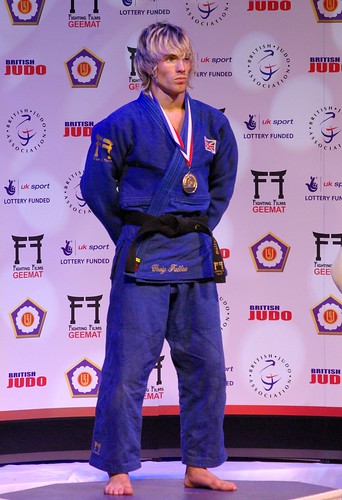
Elite Newaza: Craig Fallon Profile


Craig Fallon: Former Simultaneous World Champion/European Champion @ 60kg in Judo
Here's his Int'l and Nat'l medal count
Fallon is also one of the elite Judoka who utilize mat work in the form of pins and chokes to win matches.
Watch the below to see what I mean:


You hear a lot about the lack of mat work at all levels of Judo, in particular, elite level Judo.
This is a fair criticism, but also due to the limited time constraint on the mat. Add in the fact that a considerable portion of Judokas are primarily focused on the win by throw mentality, and win by choke or pin when it presents itself rather than spend time on the mat draining the clock in hunting for pin/submission, and you'll understand this trend.

Some notable names come to mind in discussing those Judoka that utilize mat work/newaza to win: Flavio Canto and Craig Fallon. Flavio Canto's career is so expansive, I'm saving him for a later post.

Fallon's turnover, seen at 1:52 in the video above (and posted right below), is one I have seen him use across all levels of competition. Against players from countless countries. Few escape the turnover into the pin.


Like most Judoka, Fallon began with a recreational club as a kid and eventually progressed into international competition.

Below: a short interview with some training footage of Fallon in the lead up to the 2012 London Olympics


In Judo, there are Individual 7 weight classes for each gender.
There are only 7 people, every 2 years that can be World Champion in Judo (for each gender).
There are no different champions at different belts.There are not separate master's divisions by age that are also coined "world champions".
There is only your weight class. In the entire world.
As of 1992, the open weight class was dropped from the Olympics as well. 
(There is the separate Master's event, but when you say "world championships" in Judo, the vast majority mean the senior/adult divisions by weight, not the Master's as it is held each year).


Further Reading:
Interesting and strikingly honest insight into the mindset of an elite level competitor
Interesting post about the physiological breakdown of Craig Fallon's Judo matches
Great recount of Fallon's senior career in Judo with breakdown of key matches

Off Topic:
The evolution of Judo Rules/weight classes etc

Friday, August 26, 2011

"I prefer standing Judo" ( So long as that excludes leg grabs and double legs)

                                     What's that? Standing Judo you say? Well, it's Haragoshi....
                           so it doesn't count. Seionage doesn't have to be completely standing either.
                                    Only those damn double legs aren't  the real "standing Judo".
          
I read a lot of posts by Judo purists emphasizing Judo posture and disparaging leg grabs, the double leg (wrestling). They typically dream of this mythical place where every Judoka has perfect upright posture and the gripping is limited, and perfect Ippons fall from the sky. I noticed that they rarely disparage dropping to the knees for seionage, or makikomi/rolling all the way through for tomoenage, haraighoshi, or uchimata. They don't really mean "standing Judo" completely. They mean "standing Judo" when it's applied to wrestling and pick-up techniques so they don't have to bother with sprawling or figuring out a way to counter bent over posture.


So, then, it's not really the "standing Judo" across the board which they seek...it's to ban the leg grabs and pick-ups that are typically outside of their skillset.


Were that the case they would harp on makikomi uchimata or haraigoshi or virtually all sutemi waza....but they don't.

When the russians came in with unorthodox grips and more leg grabs/pick-ups, all of a sudden, the Japanese supremacy came into question. They realized that so long as other countries, decades behind the curve, without a national sport worth of training partners had tried to play the Japanese style of Judo, Japan was elite. All of a sudden, the Japanese style was less effective against players who did not try to play as though they were Japanese.

So gripping rules were made, they disparaged the other styles of wrestling and Sambo that made it more difficult to win with the mythical "standing Judo".


                  OMG!!! Even in 1986, standing Judo at the Olympic level wasn't taking place!!!!!

Good posture is key to Judo. An emphasis on standing Judo and strong upright Ippon Judo is also wonderful and great and should be the end goal. But to disparage a group of techniques that have their place, according to Kano himself, is not in the spirit of Judo.

    - Judo Revolution

Thursday, August 25, 2011

Thoughts on the Judo World Championships: Gripping and Playing the Edge

                                      (Jimmy was right. It's all about gripping. I doubt even he knew
                                                             how true this would become)

If you're like me, you've been following the Judo World Championships in Paris the last few days. Last night after about an hour, I noted I was bored by the number of 7-11 minute matches with few discernible big throwing attempts, save in the last few minutes of regulation.
I got to thinking about my most recent tournament and some things I realized on the drive home.....

I competed recently in a regional level Judo tournament. I had semi-dislocated my elbow 3 weeks prior due to armbar/jujigatame in an MMA fight. I was unable to play right hand due to pain in my elbow and had only managed about 6-7 training sessions before the tournament.

I managed to sweep two weight classes, win all my matches by Ippon while playing predominantly left-handed. My tokuiwaza is a right Tai Otoshi with either traditional grip or a cross/same side grip.
This post isn't about how I'm the most awesome Judoka ever. It's more specifically about the importance of gripping based on the new rules in Judo. I thought back on the 2 hour drive home from the tournament. I beat several players not so much b/c I was a stronger thrower, had better conditioning, or even a wider range of strong throws.....I won b/c for the most part won the battle for grips: I kept them from getting their preferred grip and out-hustled them by attacking first in most of the exchanges. Some of these were legitimate attacks and some of these were just to make it look like I was throwing and he wasn't throwing.
When my opponents did attack, it was often  from a technically weaker position due to inferior gripping/position. I had watched their previous matches and my first order of business on the mat was keeping their preferred grip out of reach. I avoided any high collar grips or over the back grips from being placed on me, and I controlled their sleeve at the end, without letting them grip me on that side.

They eventually became anxious due to penalty for passivity or began coming forward out of frustration. Or both.
Each time this set up my finishing throw for Ippon. I actually threw my 2 toughest opponents the easiest out of the rest of the guys I faced b/c they grew anxious due to penalty or frustration and added their momentum to my throw.
--

Back to the Paris World Championships:
The banning of leg attacks and the move towards Judo being a mainly standing/throwing version of grappling (as opposed to wrestling, BJJ, Sambo et cetera) has very much increased the importance of gripping in Judo.

If you go and watch matches like I've linked below in the 60kg and 66kg category you see a much higher incidence of gripping exchanges that float to the edge of the mat with either half-hearted throws attempted or none at all. Many more matches are being thrown/won/decided at the edge of the mat following what feels like more protracted gripping exchanges than in the past.

Sobirov vs Hiroaka


Hiroaka


2 more matches in the 66kg with protracted gripping exchanges and few big throw attempts
-

-

The final of the 60kg, at my first watching seemed overly passive, almost like neither player was really looking to throw and throw big. But as I went back and rewatched the matches, my perception changed. Players that historically could attack a leg or look for a pick-up when in an uncomfortable position or being driven to the edge of the mat now must either regrip, break the opponent's grip, or hope for a referee's "matte".

Sutemiwaza which was such a common occurrence in the last Olympics was still on display in the 60 and 66 as a fall back for players out of position and wary of passivity penalties by referees.A number of players you could tell just went for a sutemiwaza just to do something rather than draw a passivity call.

In Summary:
With the new emphasis on standing Judo and the banning of leg attacks; gripping has become even more important due to new limitations on attacks. In theory, players can still set in for a pick-up or a fireman's carry/kata guruma, but the potential for hansokumake/disqualification by a referee makes this ill-advised in competition.
In addition, the combination of shidos into points has also changed the nature of matches. Once a player is penalized, the non-penalized player then pours it on in rate of attack in the hopes of the opponent being further penalized and falling behind in points, thus having to further open up and attack from potentially inferior positions.

The banning of leg attacks and the double leg/morotegari was meant to get rid of "koka" Judo and make Judo a standup grappling sport.
The Cubans were criticized for their strategy of getting ahead then riding out a lead by foot sweeping and looking busy when ahead on points.
What we now may have is a mainly grappling for position/grip sport where big throws are fewer and further between than ever.

Thoughts? Comments?